

Requirements of Cat Litter Particle Size for Equipment: Engineering Guidelines for Stable Production
Requirements of Cat Litter Particle Size for Equipment: Engineering Guidelines for Stable Production
In modern cat litter manufacturing, particle size is not only a product quality indicator but also a core parameter that determines equipment selection, process stability, and overall plant efficiency. Whether producing bentonite granules or tofu-based pellets, manufacturers must understand the Requirements of Cat Litter Particle Size for Equipment to ensure smooth material flow, proper granulation, and consistent screening performance.
From crushing and mixing to granulation and drying, every stage in a litter production line is influenced by particle size distribution. If particle size deviates from equipment design ranges, problems such as clogging, dust generation, low granulation rate, or uneven drying can occur. Therefore, defining and controlling particle size requirements is essential for both product quality and equipment longevity.
Why Particle Size Matters in Cat Litter Equipment Design?
Different equipment types are designed around specific feed size and output size ranges. The Requirements of Cat Litter Particle Size for Equipment ensure that materials enter each machine in a suitable state for processing.
Key engineering reasons include:
-
Stable feeding into granulators and mixers
-
Uniform compaction or pellet formation
-
Efficient moisture transfer during drying
-
Effective separation in screening systems
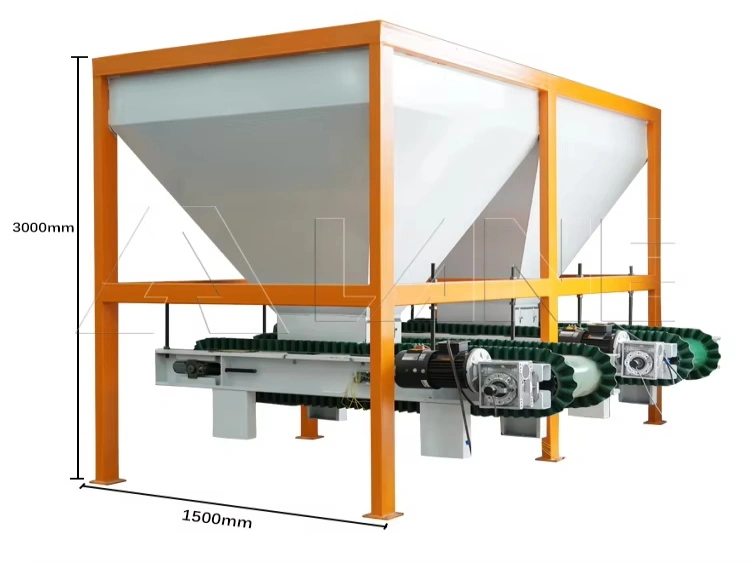
For example, if bentonite powder is too fine, it may create dust and poor compaction during granulation. If tofu fiber particles are too coarse, they may block die holes or cause pellet breakage. Matching particle size to equipment capability ensures consistent throughput and reduces wear.
Typical Particle Size Ranges for Different Cat Litter Types
Although formulations vary, most commercial cat litter products fall within predictable particle size ranges. Understanding these ranges helps define the Requirements of Cat Litter Particle Size for Equipment during plant design.
Bentonite Cat Litter
-
Raw powder: 100–300 mesh
-
Granules: 0.5–3 mm
-
Target product: 0.6–2.5 mm
Bentonite granulation relies on fine clay particles with good plasticity. Equipment such as disc or drum granulators requires feed powder within a controlled fineness window to form dense granules.
Tofu Cat Litter
-
Fiber powder: 40–80 mesh
-
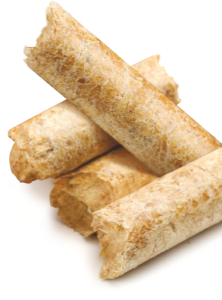
Pellets: 2–4 mm diameter
-
Length: 5–20 mm
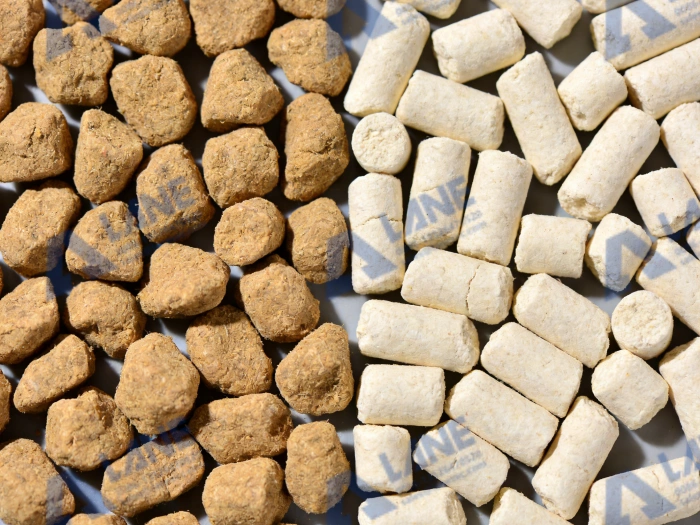
Tofu litter requires fibrous material with moderate particle size to maintain structure during extrusion. Excessively fine powder reduces pellet strength, while oversized particles block extrusion dies. These constraints define the Requirements of Cat Litter Particle Size for Equipment in tofu pelletizing systems.
Equipment Stages Influenced by Particle Size Requirements
Particle size requirements are not limited to granulation. They affect nearly every machine in a litter production line.
1. Crushing and Grinding Systems
Grinding determines whether raw materials meet the Requirements of Cat Litter Particle Size for Equipment before mixing or granulation.
Engineering targets include:
-
Achieving consistent powder fineness
-
Avoiding excessive ultra-fine dust
-
Preserving fiber structure (for tofu litter)
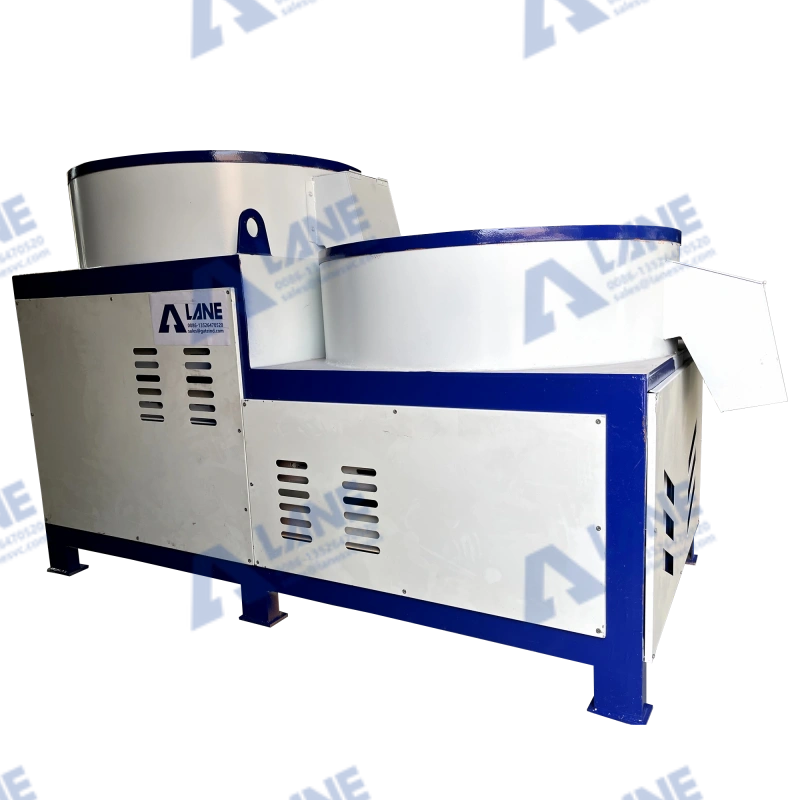
For bentonite, Raymond mills or cage crushers typically achieve the required 100–300 mesh range. For tofu litter, hammer mills or fiber crushers maintain larger particle structure.
2. Mixing and Additive Dispersion
Uniform mixing depends on compatible particle sizes among components. When particle sizes differ too much, segregation occurs.
Meeting the Requirements of Cat Litter Particle Size for Equipment during mixing ensures:
-
Even distribution of binders or starch
-
Stable moisture absorption
-
Consistent granulation behavior
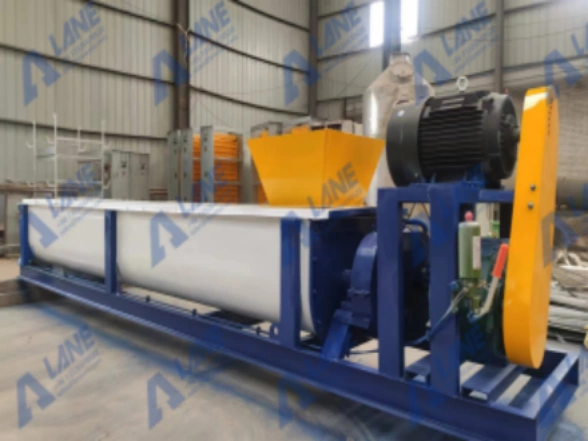
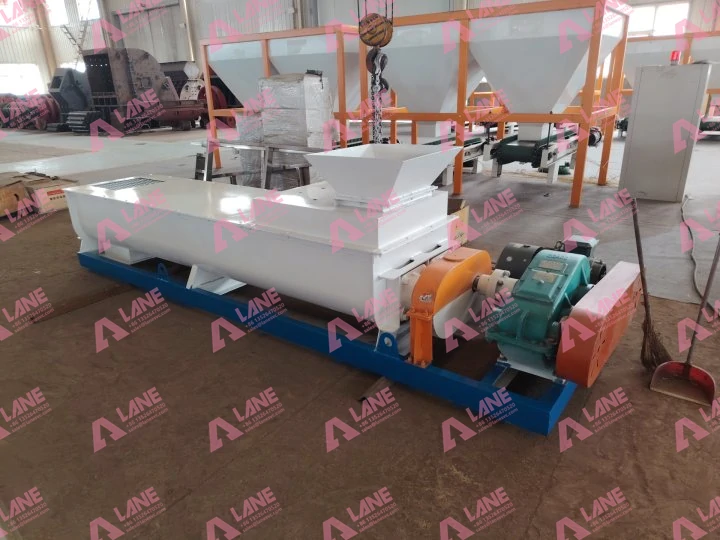
Double-shaft paddle mixers or ribbon mixers perform best when particle size variation is controlled within design limits.
3. Granulation or Pelletizing Stage
Granulation is the most sensitive stage to particle size. Both bentonite and tofu litter equipment require feed particles within specific ranges.
In bentonite disc granulators:
-
Too fine → dusting, weak granules
-
Too coarse → poor nucleation
In tofu pelletizers:
-
Too fine → brittle pellets
-
Too coarse → die blockage
Therefore, granulator design always references the Requirements of Cat Litter Particle Size for Equipment to determine feed conditioning and milling specifications.
4. Drying and Moisture Removal
Particle size also affects drying kinetics. Smaller particles dry faster but may create dust, while larger pellets retain moisture longer.
Dryers must match product particle size to:
-
Airflow velocity
-
Retention time
-
Lifting structure
If particle size falls outside the Requirements of Cat Litter Particle Size for Equipment, drying becomes uneven, leading to cracks or deformation.
5. Screening and Classification
Screening defines final product size distribution. The efficiency of vibrating or rotary screens depends directly on particle size.
When materials meet the Requirements of Cat Litter Particle Size for Equipment, screening achieves:
-
Accurate size separation
-
Low clogging risk
-
High throughput
If particles are too wet or irregular, screen blockage increases and capacity drops.
How Particle Size Affects Equipment Selection
Manufacturers often choose equipment based on capacity alone, but particle size is equally critical. The Requirements of Cat Litter Particle Size for Equipment guide several key selection decisions.
Granulator Type Selection
-
Fine powder → disc or drum granulator
-
Fibrous material → extrusion pelletizer
-
Mixed materials → compaction granulator
Particle size determines compaction mechanism and machine geometry.
Crusher and Mill Selection
Different crushers produce different size distributions:
-
Cage crusher → fine clay powder
-
Hammer mill → fibrous particles
-
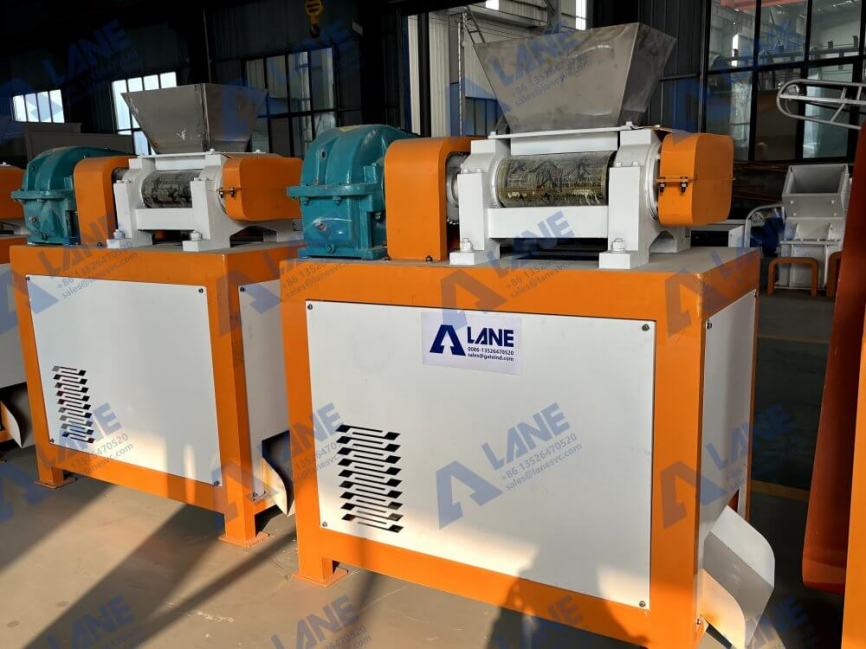
Roller mill → controlled granules
Matching crusher output to downstream requirements ensures the Requirements of Cat Litter Particle Size for Equipment are met before granulation.
Screen Mesh and Structure
Screen aperture must align with product size:
-
Bentonite: 0.5–3 mm mesh
-
Tofu: 2–5 mm slot
If screen size does not match the Requirements of Cat Litter Particle Size for Equipment, classification accuracy decreases and recycling load increases.
Common Production Problems Caused by Incorrect Particle Size
When particle size control is neglected, multiple process issues appear.
Typical problems include:
-
Granulator buildup or clogging
-
Pellet breakage after drying
-
Excess dust during handling
-
Uneven moisture distribution
-
Screening inefficiency
Most of these issues originate from failing to meet the Requirements of Cat Litter Particle Size for Equipment at earlier stages.
Engineering Methods to Control Particle Size
Stable particle size requires both equipment design and process control.
Effective methods include:
-
Multi-stage crushing
-
Air classification to remove fines
-
Controlled milling speed
-
Pre-screening before granulation
-
Moisture conditioning before pelletizing
These measures help materials consistently meet the Requirements of Cat Litter Particle Size for Equipment throughout production.
Integrated Equipment Solutions for Particle Size Stability
Advanced litter plants integrate grinding, classification, and granulation into coordinated systems. Such integration ensures particle size consistency and reduces process fluctuation.
Typical integrated configuration:
1. Raw material crusher
2. Fine mill or fiber grinder
3. Air classifier
4. Mixer with moisture control
5. Granulator or pelletizer
6. Dryer
7. Vibrating screen
Each stage is designed around the Requirements of Cat Litter Particle Size for Equipment, creating a stable and efficient production chain.
LANE Engineering Approach to Particle Size Requirements
LANE designs cat litter production lines by starting from target product size and working backward to define equipment specifications. This reverse-engineering method ensures every machine matches the required particle size window.
Key LANE advantages include:
-
Customized grinding systems for clay or biomass
-
Adjustable granulator parameters
-
Optimized screen configurations
-
Stable moisture conditioning design
-
Process matching across all equipment
By focusing on the Requirements of Cat Litter Particle Size for Equipment, LANE helps manufacturers achieve consistent granule shape, strength, and bulk density while minimizing dust and waste.
Practical Selection Guidelines for Manufacturers
When designing or upgrading a litter plant, manufacturers should evaluate particle size requirements first.
Recommended steps:
1. Define target litter size range
2. Determine raw material particle characteristics
3. Select crusher and mill accordingly
4. Match granulator type to particle behavior
5. Configure screening mesh to product size
6. Verify drying compatibility
Following these steps ensures the entire line satisfies the Requirements of Cat Litter Particle Size for Equipment and operates reliably.
Conclusion
Particle size is the hidden engineering parameter that links raw material preparation, granulation behavior, drying efficiency, and screening accuracy. Understanding the Requirements of Cat Litter Particle Size for Equipment allows manufacturers to select suitable machines, prevent production problems, and maintain consistent product quality.
Whether producing bentonite granules or tofu pellets, stable particle size distribution is essential for efficient and durable operation. With properly designed grinding, granulation, and classification systems, cat litter plants can achieve high output, low dust, and uniform particles.
By aligning equipment design with particle size requirements, manufacturers build reliable and scalable cat litter production lines capable of meeting modern market standards.
For more details, please feel free to contact us.
Henan Lane Heavy Industry Machinery Technology Co., Ltd.
Email: sales@lanesvc.com
Contact number: +86 13526470520
Whatsapp: +86 13526470520