

Cassava Cat Litter Raw Material Processing: Preparation, Challenges, and Process Control
Cassava Cat Litter Raw Material Processing: Preparation, Challenges, and Process Control
Introduction
As demand for plant-based and biodegradable cat litter continues to grow, cassava has emerged as a promising raw material due to its high starch content and wide availability. However, successfully converting cassava into stable cat litter products depends heavily on cassava cat litter raw material processing, rather than on formulation alone.
Unlike mineral or silica-based materials, cassava behaves dynamically during moisture adjustment, mixing, and forming. If raw material processing is not properly designed, manufacturers may encounter issues such as excessive stickiness, unstable pellet formation, or downstream drying inconsistency. This makes cassava cat litter raw material processing a foundational step that directly influences overall production efficiency and final product performance.
Understanding Cassava as a Cat Litter Raw Material
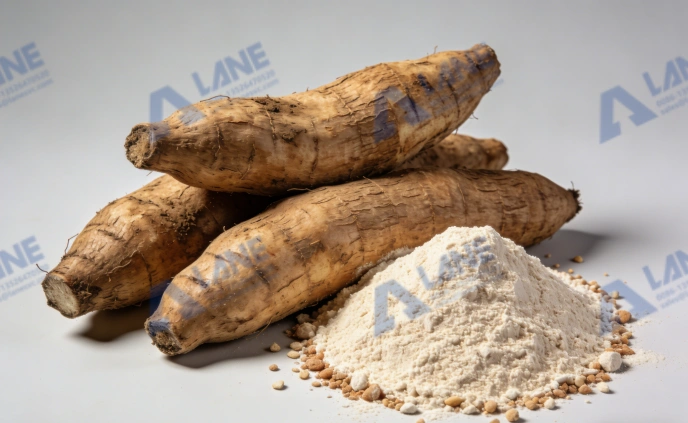
Cassava-based materials differ significantly from soybean residue or corn-based inputs commonly used in tofu cat litter. The defining characteristic of cassava is its high starch concentration, which reacts quickly to moisture and temperature changes.
From a processing perspective, cassava raw material tends to:
-
Absorb water rapidly
-
Become adhesive under compression
-
Undergo partial gelatinization if exposed to heat too early
These properties make cassava suitable for pellet formation but also increase sensitivity during early-stage processing. Effective cassava cat litter raw material processing begins with recognizing these material behaviors and designing preparation steps that maintain control rather than forcing premature bonding.
Why Raw Material Processing Matters in Cassava Cat Litter Production
In cassava-based production lines, raw material processing determines whether later stages operate smoothly or require constant correction. Many issues that appear during pelletizing or drying actually originate in earlier preparation steps.
Proper cassava cat litter raw material processing serves three main purposes:
-
Stabilizing moisture distribution before forming
-
Reducing variability in particle behavior
-
Preventing uncontrolled starch activation
When cassava raw material enters mixing or pelletizing stages with inconsistent moisture or uneven particle size, equipment performance becomes unstable. This leads to fluctuating pellet density, increased fines, and higher rejection rates.
Key Challenges in Cassava Cat Litter Raw Material Processing
Processing cassava for cat litter introduces challenges that are distinct from other organic materials.
1.Moisture Control Sensitivity
Cassava absorbs water quickly but releases it slowly. Over-wetting during early processing can result in sticky masses that are difficult to convey or mix evenly. Under-wetting, on the other hand, reduces binding efficiency during pellet formation.
2.Premature Agglomeration
If cassava particles experience excessive pressure or friction too early, starch may begin bonding before forming stages. This creates irregular lumps rather than controlled granules.
3.Heat Exposure Risks
Even moderate heat during preparation can partially gelatinize starch, changing material behavior downstream. This is why cassava cat litter raw material processing must be carefully separated from high-temperature stages such as drying.
Addressing these challenges requires a process-oriented approach rather than relying on a single piece of equipment.
Processing Stages Before Pelletizing
Effective cassava cat litter raw material processing typically includes several coordinated stages before pelletizing begins.
First, size reduction or conditioning ensures incoming cassava material is within a controllable particle range. Oversized fragments create uneven moisture absorption, while excessive fines increase stickiness.
Next, controlled mixing distributes moisture and optional binders evenly across particles. At this stage, the goal is uniformity—not compaction. Mixing intensity must be sufficient to homogenize material without triggering premature bonding.
Finally, short-term stabilization allows moisture to equilibrate within particles before forming. Skipping this step often results in pellets that look acceptable initially but fail during drying or screening.
Equipment Logic for Cassava Raw Material Preparation
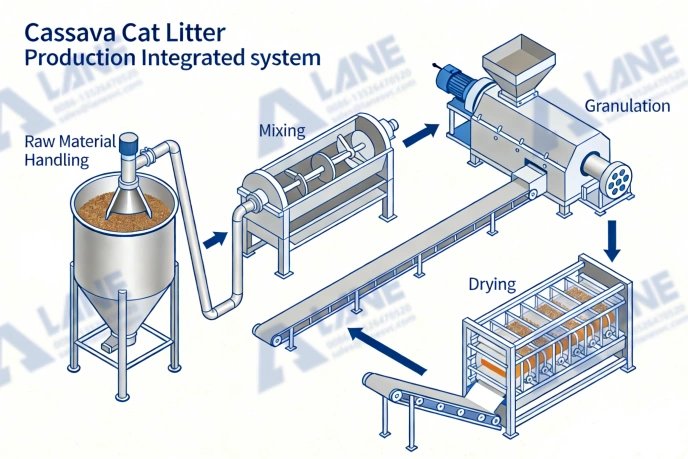
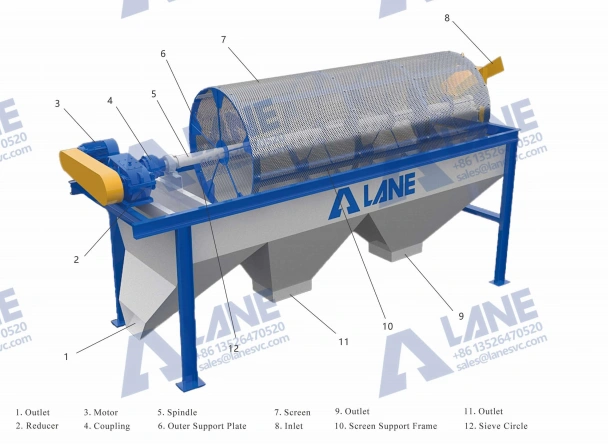
Rather than focusing on individual machines, cassava cat litter raw material processing should be viewed as an integrated system. Each piece of equipment supports a specific function within the preparation logic.
Pre-processing equipment ensures material uniformity. Mixing equipment balances moisture without overworking starch-rich material. Conveying systems must minimize shear and heat buildup to avoid unintended reactions.
From an equipment integration perspective, manufacturers with experience in organic fertilizer processing often apply similar principles when handling cassava-based materials. This cross-industry knowledge helps reduce trial-and-error during line setup.
Quality Control Points in Cassava Cat Litter Raw Material Processing
Beyond equipment selection and process flow design, consistent quality output depends on how well critical control points are managed during cassava cat litter raw material processing. These control points are often subtle but have a direct impact on downstream stability.
One of the most important quality indicators is material consistency at the end of raw material preparation. If cassava particles leave the preparation stage with uneven moisture distribution or partial agglomeration, these issues will amplify during pelletizing and drying. Even advanced forming equipment cannot fully compensate for unstable input material.
Another key control point lies in process timing. Cassava cat litter raw material processing requires sufficient conditioning time to allow moisture migration within particles, but excessive holding can increase the risk of surface stickiness. Balancing this timing helps ensure that material remains free-flowing while retaining adequate binding potential.
Finally, continuous observation of raw material behavior—such as flowability, surface texture, and temperature rise—provides early warning signs of processing deviation. Manufacturers that establish these monitoring habits often experience fewer quality fluctuations and lower maintenance pressure on downstream equipment.
Integrating Cassava Processing into a Full Cat Litter Production Line
Cassava raw material processing does not end once material reaches the pelletizer. Its effectiveness becomes evident in how smoothly the material transitions into forming, drying, and screening stages.
Well-prepared cassava material:
-
Forms pellets with consistent density
-
Responds predictably to drying
-
Produces fewer fines during screening
This allows downstream equipment to operate within stable parameters, reducing mechanical stress and maintenance requirements. As production capacity scales, robust cassava cat litter raw material processing becomes even more critical to maintaining product consistency across batches.
Process Experience and Industrial Background
Manufacturers with backgrounds in fertilizer and organic material processing often approach cassava cat litter raw material processing with a system-level mindset. Rather than isolating issues to single machines, they focus on how material behavior evolves across stages.
This process-driven approach supports long-term production stability and simplifies future line expansion. By aligning raw material preparation with forming and drying requirements, producers can avoid frequent adjustments and achieve more predictable results.

Conclusion: Building a Stable Foundation for Cassava Cat Litter Manufacturing
Cassava offers strong potential as a sustainable cat litter raw material, but its successful use depends on thoughtful preparation. Cassava cat litter raw material processing is not a minor preliminary step—it is the foundation that determines whether the entire production line operates efficiently.
By focusing on material behavior, moisture control, and equipment coordination, manufacturers can transform cassava from a challenging input into a reliable production resource. A well-designed processing strategy not only improves pellet quality but also supports scalable, long-term manufacturing performance.
For more details, please feel free to contact us.
Henan Lane Heavy Industry Machinery Technology Co., Ltd.
Email: sales@lanesvc.com
Contact number: +86 13526470520
Whatsapp: +86 13526470520